Communications Agents Overview
Last updated: September 29, 2026
Overview
A communications agent places outbound calls to clients, insurers, treatment facilities, or other parties associated with your matters. It is a voice agent, run from a matter, that handles routine calling such as treatment check-ins and claim status follow-ups.
Nothing is dialed without approval. The agent builds a call plan from the matter first, and a person edits and approves it before any call goes out.
How a Run Goes
The plan. Starting the agent pulls in matter context and generates a comms plan.
The approval. The plan can be edited and has to be approved. Nothing is dialed before this.
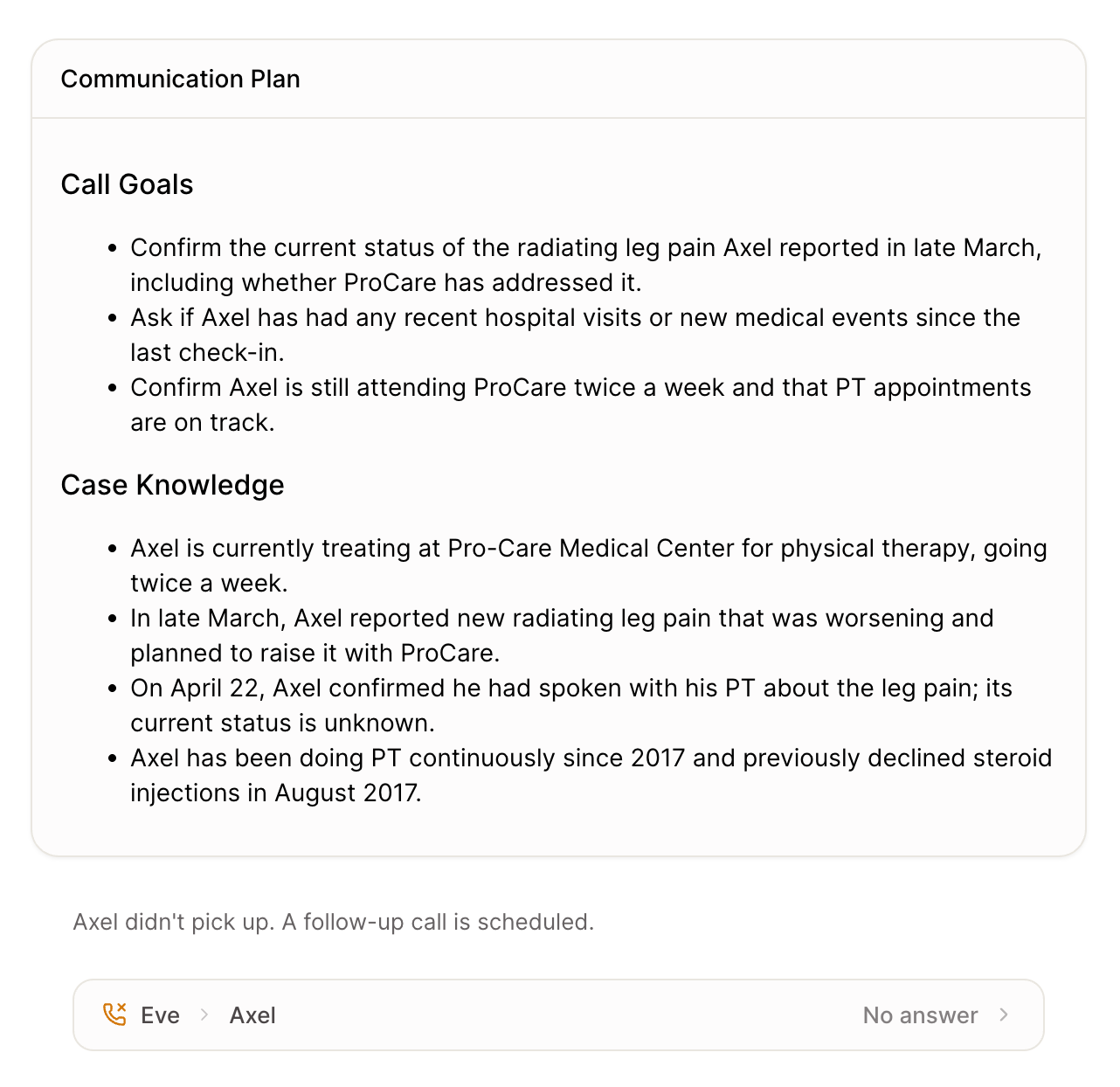
The call. The first call is scheduled once the plan is approved, and can be rescheduled or started immediately. The agent places it and retries where needed.
The record. A transcript and a post-call summary land on the matter, and a notification goes out when the call completes.
What It Can Do on a Call
Navigate phone menus, working through IVRs using DTMF tones.
Handle voicemail. Voicemail is detected, and the agent either hangs up, leaves a fixed message, or speaks a generated one. The detection window is configurable.
Transfer to a person, warm or cold, with optional hold music and a private brief read to the colleague before connecting.
Speak over 30 languages. Ask Jenny to use another language when calling a client to reach out in their native tongue.
Produce a full transcript with speaker attribution separating the agent, the person called, a transfer recipient, tool calls, and DTMF input.
What It Is Used For
Ready to use: treatment check-ins.
Early preview, usable but still changing: medical records follow-ups, claim status follow-ups, proactive case updates, and discovery information gathering.
What Communications Agents Do Not Do
They do not call without approval. The plan is a required step, not a preview that can be skipped.
They do not take incoming calls. Inbound intake is Voice AI, which is a different thing.
They do not decide what to do with the answer. The transcript and summary land on the matter for a person to act on.
Key Terms
Comms plan: The call plan generated from matter context, edited and approved before any call is placed.
Warm transfer: A handoff where the agent briefs the colleague before connecting the call. A cold transfer connects without that brief.
DTMF: The tones a phone keypad sends, which the agent uses to move through automated menus.
Trigger: What starts the agent: a case update, an Auditor finding, a schedule, or a person.